 Flamingo
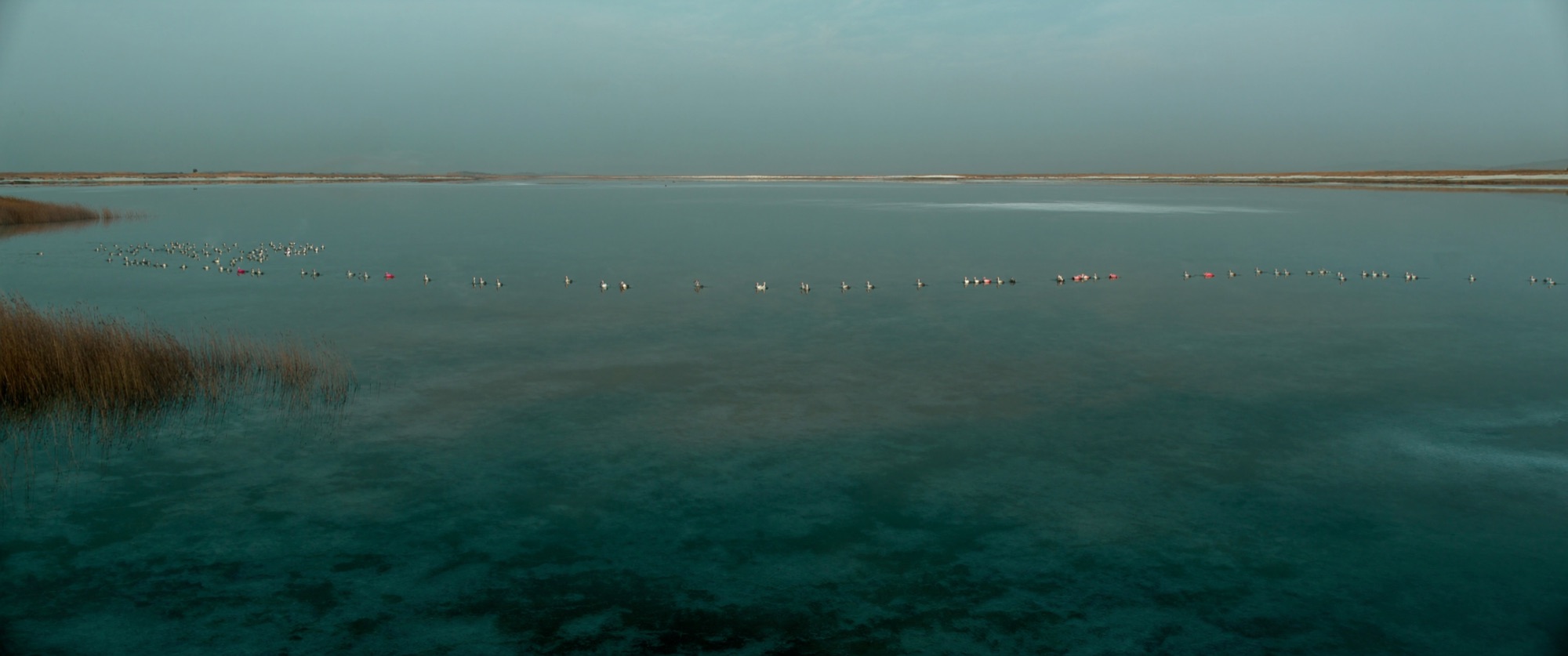
Greater flamingos (Phoenicopterus roseus) usually winter in Cyprus from November to the end of February; that is how BirdLife Cyprus describes the species in its species profile. Visit Cyprus and the Larnaka Tourism Board set the window wider, at November to March, because individual groups stay on at the lake for longer. On average, 5,000 to 10,000 birds spend the winter on the island, spread across five wetlands (Nikos Kassinis, Game and Fauna Service, in Cyprus Mail, 08.12.2025). The large gatherings are at Larnaca Salt Lake and Akrotiri Salt Lake. Paralimni Lake near Sotira belongs to the same five sites, but it is a smaller stopover: at the waterbird count in January 2021, 906 waterbirds of all species were recorded there, against 10,431 at the Larnaca salt lakes in the same round. All figures as of August 2026; check before travelling.
Season: November to the end of February, stragglers into March
BirdLife Cyprus lists the greater flamingo in its species profile as a winter visitor and passage migrant, and gives the rule of thumb as arrival in November and departure by the end of February. In favourable conditions individual birds stay longer, mostly juveniles, subadults and non-breeding adults, in some cases into the summer months. How long they stay and how many arrive depends largely on water depth, according to BirdLife Cyprus: if the water is too deep or too shallow, the birds move on.
The tourism sources set the window wider. Visit Cyprus writes of thousands of flamingos staying between November and March, and the Larnaka Tourism Board of birds that arrive with the first wet weather, typically in November, and stay at the lake until around March.
Where the accounts contradict one another, BirdLife Cyprus is the more reliable source, for a reason that can be checked: the organisation co-ordinates the midwinter waterbird count every year together with the state Game and Fauna Service, and systematic counts have been running since 1992. The tourism sites give a rough time of year to travel, without surveys of their own. In practice that means December, January and February are the most dependable months, and March can be noticeably emptier.
The winter of 2025/26 shows how much the start can vary. On 8 December 2025 Cyprus Mail reported the first wave at Larnaca Salt Lake and spoke of a few hundred birds. Anyone planning a trip around the birdwatching should therefore not count on a fixed date in the calendar, but look at the current reports from BirdLife Cyprus before booking. The season figures given here are as of August 2026.
How many birds there actually are
The numbers vary considerably from year to year. Nikos Kassinis, a senior officer at the Game and Fauna Service, gave an average of 5,000 to 10,000 wintering flamingos across five Cypriot wetlands in December 2025 (Cyprus Mail, 08.12.2025). Cyprus therefore holds more than one per cent of the eastern Mediterranean population (Politis, 03.12.2025).
Individual winters turn out very differently. In January 2016 BirdLife Cyprus reported around 12,500 flamingos at Larnaca Salt Lake and a further 2,500 at Akrotiri Salt Lake. At the midwinter waterbird count over the weekend of 16 and 17 January 2021, 7,758 flamingos were recorded island-wide, the commonest species among a total of 16,745 waterbirds from 68 species, recorded by around 20 counters at 50 wetlands.
The swings downwards are just as marked. In January 2025 only 30 flamingos were counted at Akrotiri Salt Lake, a figure that low for the first time since systematic counts began in 1992, according to BirdLife Cyprus. Over the longer term, flamingos wintering in Cyprus have declined by 14 to 31 per cent since 2013. That is what Kassinis says in Cyprus Mail (08.12.2025), and the same analysis was presented at the 4th International Flamingo Symposium in Italy from 10 to 15 November 2025 (Politis, 03.12.2025).
The reasons Kassinis gives are frequent droughts, inflows of poor-quality water with correspondingly less food, and pressure from building and incompatible land uses around the wetlands.
For trip planning that means flamingos are likely in the winter months, but no guarantee can be derived from it.
The five stopover sites at a glance
Cyprus Mail names five core wetlands: Akrotiri near Limassol, the Larnaca salt lakes, Paralimni Lake, Oroklini Lake and further lakes in the Famagusta district.
Larnaca Salt Lake: the island's highest documented flamingo numbers come from here, around 12,500 birds in January 2016 (BirdLife Cyprus). The Larnaka Tourism Board writes that at higher water levels the figure can run into the tens of thousands. The lake is a complex of four basins: the main lake, Aliki, plus Orphani, Soros and the airport lake. The sources contradict one another on area: Visit Cyprus gives 2.2 square kilometres for the main lake and 1,761 hectares for all four together, while the Larnaka Tourism Board gives the same 2.2 square kilometres for the whole four-lake complex. The Ramsar figure is the more reliable one, because it describes a legally fixed site boundary: Ramsar Site No. 1081 covers 1,107 hectares and has been designated since 11 July 2001. The Ramsar information sheet also records that the water level does not exceed one metre. The site has been under Cypriot nature conservation law since 1997, and to that are added Natura 2000, the status of Special Protected Area under the Barcelona Convention and recognition as an Important Bird Area. Salt extraction ended in 1986. At the main lake, Aliki, there is an observation tower and a four-kilometre nature trail with two access points, at the Kamares aqueduct and at the salt collection area on Artemis Avenue; the trail is part of the European long-distance path E4.
Akrotiri Salt Lake: at 10.65 square kilometres it is, according to Visit Cyprus, the largest inland body of water on the island. Over more than half its area the water is about 30 centimetres deep, at most around one metre, and the lowest point lies 2.7 metres below sea level. The wetland complex of the salt lake and the Fassouri marshes has been a Ramsar site since 20 March 2003 (Site No. 1375, 2,171 hectares) and is listed as an Important Bird Area as well. It lies within the British Sovereign Base Area of Akrotiri, which can matter for getting there and for access rules. Across the whole Akrotiri peninsula, more than 300 bird species have been recorded according to BirdLife Cyprus; that figure applies to the peninsula and not to the lake alone.
Oroklini Lake: around 50 hectares, according to BirdLife Cyprus the smallest Natura 2000 site in Cyprus, designated as a Special Protection Area under the Birds Directive and as a Site of Community Importance under the Habitats Directive. BirdLife Cyprus counts 190 recorded bird species and names the black-winged stilt and the spur-winged lapwing as the two most important breeding species; a hide was built as part of a restoration project. Cyprus Mail lists the lake among the five flamingo wetlands, although the site description by BirdLife Cyprus puts other species to the fore.
Paralimni Lake: the stopover site in the neighbourhood
Paralimni Lake lies in the hollow between Paralimni, Sotira and Deryneia, and so in the same cluster of villages as Sotira. A documented distance from the Flamingo Lake Resort to the nearest accessible point on the shore cannot be given at present: the route planners do not list the address, and the flat will not be ready for occupation until March 2027. As soon as the route can be measured properly, we will add it here with kilometres, minutes and mode of transport. For access, the Birdingplaces platform describes a car park behind the Super Action market and the Lidl supermarket, from where an unsurfaced road runs parallel to the lake (Birdingplaces, user-generated information, as of August 2026).
There are two figures for the area. BirdLife Cyprus gives around 350 hectares, while the Natura 2000 site Limni Paralimniou (CY3000008) is listed in the European register of protected areas at 272.56 hectares. Neither of the two sources says where the difference comes from. For official purposes the Natura 2000 figure is the one that counts, because it describes the legally fixed site boundary.
The lake has been recognised as an Important Bird and Biodiversity Area since 2004 and has been a Natura 2000 site since 2009, under both EU directives, because alongside the birds the rare endemic subspecies of grass snake, Natrix natrix cypriaca, is protected here as well. BirdLife Cyprus counts at least 186 recorded bird species; Martin Hellicar, director of BirdLife Cyprus, speaks in the Cyprus Mail of well over 180. The greater flamingo is among them, and as important breeding birds BirdLife Cyprus names the spur-winged lapwing, the black-winged stilt and the Kentish plover.
A counted comparison for scale: at the waterbird count in January 2021, 906 waterbirds of all species were recorded at Paralimni Lake, against 10,431 at the Larnaca salt lakes in the same round. Those are totals across all species and not flamingo figures on their own.
The pressures are part of the picture. A clay pigeon shooting range without environmental permission lies inside the Natura 2000 site. It has stood there for years, although the state had also given the EU an undertaking to move it, and only an earth bank separates it from the main body of the lake (Cyprus Mail, 16.03.2022). On around 30 per cent of the area there is hunting every day in November and December (BirdLife Cyprus). Added to that are uncontrolled drainage for agriculture and neighbouring properties, three go-kart tracks cut into the lake mud, one of which is still in use, as well as poaching and illegal dumping of rubbish. The lake begins to dry out from around May, so a visit is worthwhile before then (Birdingplaces, user-generated information, as of August 2026).
Why the flamingos come
The reason is Artemia salina, a small brine shrimp. Visit Cyprus describes it as a basic element of the food chain in the salt lakes. The lakes fill with the winter rains and dry out in summer to a salt crust; the shrimp's eggs survive this dry phase and hatch as soon as the salinity falls with the rainwater. That is the phase in which the most food is available to the flamingos.
A great deal therefore depends on the water level. Visit Cyprus writes that flamingos and other waterbirds leave the salt lakes and move on to Akrotiri Salt Lake or southwards to Africa if they do not find the shrimps.
The pink colouring comes through the diet: carotenoids from algae, plankton and small crustaceans are deposited in the plumage. Juveniles are greyish brown and turn pink after two to four years, according to BirdLife Cyprus. Adult birds measure 120 to 145 centimetres.
Ringing recoveries show where the birds come from. Birds from Iran, Algeria, Turkey, Sardinia, Spain, Morocco, Azerbaijan, France and Egypt have been documented.
Breeding attempts have been documented in Cyprus since 2001. BirdLife Cyprus records a first suspected breeding in 2001, abandoned nest mounds in 2003 and a few eggs in 2005 at Akrotiri Salt Lake, where the attempt failed when the water level dropped too far; further attempts followed in 2012 and 2015. After the exceptionally wet winters of 2018/19 and 2019/20, hundreds of flamingos stayed through the summer and began building in at least three places around Akrotiri Salt Lake. Around 200 nests were counted, and remains of eggshells were found later. No chicks were seen. The attempts in 2021 and 2022 were likewise without success. The island does not therefore count as an established breeding colony.
Getting there from Sotira, equipment and time of day
This means Sotira in the Famagusta district; there is a second village of the same name in the Limassol district, which can produce wrong results when entered into route planners.
For Larnaca Salt Lake, the route planner Rome2Rio calculates 40.2 kilometres and around 43 minutes by car from Sotira, and estimates the fuel cost at 6 to 9 euros. A taxi likewise takes around 43 minutes and costs an estimated 45 to 60 euros. Without a car of your own, an hourly direct bus run by OSEA (Famagusta District Transport Organisation) goes from Sotira in around 1 hour 6 minutes for 2 to 4 euros, and a second bus option takes 1 hour 22 minutes. From Ayia Napa the same connection takes around 1 hour 19 minutes.
Akrotiri Salt Lake is around 125 road kilometres and about 1 hour 44 minutes by car from Sotira; Rome2Rio lists the lake under the name Limassol Salt Lake. By public transport this route is laborious: there is no direct bus, and the fastest bus connection takes around 3 hours 53 minutes with a change, according to Rome2Rio, and costs 32 to 40 euros.
All travel figures come from Rome2Rio, as of August 2026. Check timetables and fares with the transport operator before travelling.
On the best time of day, the sources checked give no reliable information. The code of conduct of BirdLife Cyprus requires that birds not be flushed more often than every two hours, and not within two hours after sunrise or before sunset, so that they can feed and rest. That is a rule for all bird species and a rule about how often birds are disturbed; no peak in flamingo activity can be derived from it. Recommendations about the time of day on travel sites should therefore be treated as unverified.
On equipment the sources checked give no information, so which binocular magnification is sufficient is left open here. One other pointer is documented, though it carries a date: in January 2016 BirdLife Cyprus announced that it would be at Larnaca Salt Lake every weekend with telescopes, to show visitors the flamingos from a safe distance. Whether that will take place again in the 2026/27 season does not follow from it; that would have to be asked of BirdLife Cyprus before travelling. The observation tower at the main lake, Aliki, is available regardless.
Protected status and rules of conduct
All the main stopover sites described here are formally protected. Larnaca Salt Lake has been a Ramsar site since 11 July 2001 (Site 1081), as well as a Natura 2000 area, a Special Protected Area under the Barcelona Convention and an Important Bird Area. The Akrotiri wetland complex has been a Ramsar site since 20 March 2003 (Site 1375); the Ramsar information sheet lists 45 bird species of Annex I of the EU Birds Directive and eleven habitat types of Annex I of the Habitats Directive there. Paralimni Lake has been an Important Bird and Biodiversity Area since 2004 and a Natura 2000 site since 2009.
One clear rule for visitors appears on the page of the Larnaka Tourism Board: wading into the salt lake to get closer to the flamingos is prohibited and harms these sensitive birds. In its Code of Good Practice, BirdLife Cyprus gives a simple measure for the distance: "if a bird flies away or makes repeated alarm calls, you're too close." In other words, if a bird takes flight or gives repeated alarm calls, you are too close.
BirdLife Cyprus also names drone flights over the birds, photography at close range and approaching on foot as sources of disturbance. They cost the birds energy they need for migration and can drive them off their feeding areas. Watching is therefore done from designated hides; as examples BirdLife Cyprus names Oroklini Lake, Larnaca Salt Lake and the Akrotiri Environmental Education Centre.
One further problem does not affect visitors directly, but it does explain how sensitive these sites are: since 2020, 169 flamingos with lead poisoning have been registered at the Larnaca lake complex. A law from 2023 prohibits lead shot near wetlands, but according to BirdLife Cyprus it is not being enforced (Cyprus Mail, 07.04.2026).
Frequently asked questions
When can you see flamingos in Cyprus?
Usually from November to the end of February. BirdLife Cyprus describes the greater flamingo in its species profile as a winter visitor that arrives in November and departs again by the end of February. Visit Cyprus and the Larnaka Tourism Board give the somewhat wider window of November to March. The start depends on the first wet weather: in the winter of 2025/26, Cyprus Mail reported the first wave on 8 December 2025. The most dependable months are December to February. As of August 2026.
Which flamingo species comes to Cyprus?
The greater flamingo, scientifically Phoenicopterus roseus, called Rosaflamingo in German. BirdLife Cyprus gives the body length as 120 to 145 centimetres. Juveniles are greyish brown and turn pink after two to four years; the colouring comes from carotenoids in their food. Other flamingo species are not to be expected regularly in Cyprus. In older official documents, such as the Ramsar information sheet for Larnaca Salt Lake, the species still appears under its former name Phoenicopterus ruber.
How many flamingos winter in Cyprus?
On average 5,000 to 10,000 birds spread across five wetlands, according to Nikos Kassinis of the Game and Fauna Service in Cyprus Mail, 08.12.2025. Individual winters differ sharply: in January 2016 BirdLife Cyprus reported around 12,500 birds at Larnaca Salt Lake alone and 2,500 at Akrotiri, and at the count on 16 and 17 January 2021 the island-wide figure was 7,758. Numbers have fallen by 14 to 31 per cent since 2013.
Can you see flamingos at the lake near Sotira and Paralimni?
Paralimni Lake is one of the five wetlands that Cyprus Mail names for the species, citing the Game and Fauna Service, and BirdLife Cyprus lists the greater flamingo in its site description. It is, however, a smaller stopover site: at the waterbird count in January 2021, 906 waterbirds of all species were recorded there, against 10,431 at the Larnaca salt lakes in the same round. Anyone who wants to see large flocks drives to Larnaca.
Where do you see the largest flocks of flamingos in Cyprus?
At Larnaca Salt Lake and Akrotiri Salt Lake. The highest documented numbers come from Larnaca: around 12,500 birds in January 2016 (BirdLife Cyprus); the Larnaka Tourism Board writes that at higher water levels the figure can run into the tens of thousands. At 10.65 square kilometres, Akrotiri is the largest inland body of water on the island according to Visit Cyprus, but the numbers there vary widely: in January 2025 only 30 birds were counted.
Why do the flamingos come to Cyprus at all?
Because of the brine shrimp Artemia salina, which Visit Cyprus describes as a basic element of the food chain in the salt lakes. The lakes fill with the winter rains, the falling salinity lets the dormant shrimp eggs hatch, and the flamingos filter them out of the shallow water. If the birds do not find the shrimps, they move on to Akrotiri Salt Lake or southwards to Africa, according to Visit Cyprus.
Which time of day is best for watching?
On this the sources checked give no reliable information, and recommendations to that effect on travel sites are unverified. The code of conduct of BirdLife Cyprus requires that birds not be flushed more often than every two hours, and not within two hours after sunrise or before sunset, so that they can feed and rest. That is a general disturbance rule for all bird species; no peak in flamingo activity can be derived from it.
How close may you get to the birds?
Far enough away that the birds do not react. In its Code of Good Practice, BirdLife Cyprus gives the criterion: "if a bird flies away or makes repeated alarm calls, you're too close." Wading into the salt lake to get closer is prohibited, according to the Larnaka Tourism Board. Drone flights, photography at close range and approaching on foot count as disturbance for BirdLife Cyprus. As examples of designated hides, BirdLife Cyprus names Oroklini Lake, Larnaca Salt Lake and the Akrotiri Environmental Education Centre.
Do flamingos breed in Cyprus?
Not regularly. BirdLife Cyprus documents breeding attempts since 2001: a first suspected breeding in 2001, abandoned nest mounds in 2003, a few eggs in 2005 at Akrotiri Salt Lake, and further attempts in 2012 and 2015. After the exceptionally wet winters of 2018/19 and 2019/20, around 200 nests were counted around Akrotiri Salt Lake and remains of eggshells were found later, but no chicks were seen. The attempts in 2021 and 2022 were also without success. The island does not therefore count as an established breeding colony.
Why are there fewer of them from year to year?
Nikos Kassinis of the Game and Fauna Service names frequent droughts, inflows of poor-quality water with correspondingly less food, and pressure from building and incompatible land uses around the wetlands. Lead poisoning comes on top of that: since 2020, 169 flamingos with lead poisoning have been registered at the Larnaca lake complex; a law from 2023 against lead shot near wetlands is not being enforced, according to BirdLife Cyprus. The decline since 2013 is 14 to 31 per cent.
Sources
Every figure on this page comes from the sources listed below. Last checked: August 26, 2026. Please still check for yourself before you travel — prices and timetables change.
- BirdLife Cyprus: When the Salt Lakes turn pink – The Greater Flamingos of Cyprus (breeding attempts since 2001, wet winters of 2018/19 and 2019/20, around 200 nests, ring recoveries, 30 birds at Akrotiri in January 2025, systematic counts since 1992, hides, drones)
- BirdLife Cyprus: species profile Greater Flamingo (winter visitor, November to the end of February, 120–145 cm, two to four years until the pink colouring appears)
- BirdLife Cyprus: Almost 17,000 waterbirds wintering at the wetlands of Cyprus (count of 16/17 January 2021: 7,758 flamingos, 16,745 waterbirds, 68 species, 20 counters, 50 wetlands, Paralimni 906, Larnaca 10,431; coordinated jointly with the Game and Fauna Service)
- BirdLife Cyprus, January 2016: 15,000 Flamingos at Larnaka and Akrotiri Salt Lakes this year (12,500 Larnaca, 2,500 Akrotiri; announcement of the telescope weekends at Larnaca Salt Lake)
- BirdLife Cyprus: Paralimni Lake (around 350 ha, at least 186 bird species, IBA 2004, Natura 2000 2009, Natrix natrix cypriaca, hunting on 30 per cent of the area daily in November and December, shooting range without an environmental permit)
- BirdLife Cyprus: Code of Good Practice (flushing rule and distance criterion)
- BirdLife Cyprus: Oroklini Project (around 50 ha, the smallest Natura 2000 site in Cyprus, SPA and SCI, 190 bird species, hide)
- Visit Akrotiri (BirdLife Cyprus): Birds – over 300 bird species on the Akrotiri peninsula
- Cyprus Mail, 08.12.2025: First flamingos reach Cyprus, fewer expected this year (Nikos Kassinis, 5,000–10,000 birds, five wetlands named, decline of 14–31 per cent since 2013, reasons)
- Politis, 03.12.2025: A Silent Warning Over Cyprus' Flamingos (more than one per cent of the eastern Mediterranean population, 4th International Flamingo Symposium in Italy, 10–15.11.2025)
- Cyprus Mail, 07.04.2026: Flamingos dying of lead poisoning as 'state turns blind eye' (169 cases since 2020, the 2023 lead shot law not implemented)
- Cyprus Mail, 16.03.2022, Martin Hellicar (BirdLife Cyprus): Paralimni lake – a wetland gem in need of some TLC (shooting range, earth bank, EU commitments, three go-kart tracks in the lake mud, drainage, over 180 species)
- Ramsar Sites Information Service: Larnaca Salt Lake, Site No. 1081 (1,107 ha, designated 11.07.2001, water level never exceeds one metre, Artemia salina, protected area since 1997)
- Ramsar Sites Information Service: Akrotiri, Site No. 1375 (2,171 ha, designated 20.03.2003, Important Bird Area, salt lake and the Fassouri marshes, Western Sovereign Base Area, 45 bird species listed in Annex I of the Birds Directive)
- Deputy Ministry of Tourism (Visit Cyprus): Larnaka Salt Lake (main lake 2.2 km², 1,761 ha across four lakes, Ramsar and Natura 2000, protected since 1997, Artemia salina, 4 km nature trail, salt extraction until 1986)
- Visit Cyprus: Akrotiri Salt Lake (10.65 km², the largest inland body of water on the island, water depth around 30 cm over half the area, at most about 1 m, deepest point 2.7 m below sea level, November to March)
- Larnaka Tourism Board: Flamingos & Salt Lake (arriving with the first rain, staying until about March, no wading, observation tower at the main lake Aliki, 4 km trail with two access points, part of the E4, Ramsar, Natura 2000, Barcelona Convention, IBA)
- Rome2Rio: Sotira (Famagusta) – Larnaca Salt Lake (40.2 km / 43 minutes by car, hourly OSEA direct bus taking 1 h 6 min for 2–4 euros, as at 08/2026)
- Rome2Rio: Sotira (Famagusta) – Limassol Salt Lake, the name used there for the Akrotiri Salt Lake (125 km / 1 h 44 min by car, no direct bus, fastest bus connection 3 h 53 min, as at 08/2026)
- Birdingplaces: Paralimni Lake (car park behind the Super Action market and Lidl, unsurfaced road running along the lake, visit before May, over 180 species; user-generated platform)
- Wikipedia: Larnaca Salt Lake (total area of the four lakes 2.2 km², named Aliki, Orphani, Soros, Spiro; tertiary source, used here only to place the conflicting area figures in context)
- Natura 2000 / EUNIS: Limni Paralimniou protected area (CY3000008), designated area 272.56 hectares