 Flamingo
Since 1 January 2021, drones in Cyprus have been subject to EU rules. In the open category that means no higher than 120 metres, always within sight, and nothing dropped. Anyone flying a drone over 250 grams or with a camera must be registered as an operator, in the EASA state where they live, meaning an EU country, Switzerland, Liechtenstein, Norway or Iceland; the number is valid in all of these states. You only register in Cyprus if you live there, or if you live outside the EASA states, for example in the United Kingdom, and Cyprus is the first country where you fly; registration through drones.gov.cy costs 15 euros. What matters most on the ground is the civil aviation department's official geo-zone map: the file of 6 May 2025 contains 141 zones, 29 where flying is prohibited and 112 where it needs authorisation. By our analysis, there are several National Guard zones around Sotira where electronic countermeasures may bring a drone down, plus zones run by the Electricity Authority and around Famagusta General Hospital and police buildings. According to the department, the Cyprus map preinstalled on many DJI drones is not the correct one.
The basic rules of the open category
Since 1 January 2021, every drone in Cyprus, from small consumer devices to large aircraft, has been subject to EU legislation drawn up by the European Union Aviation Safety Agency (EASA). As everywhere in the EU, the Cyprus Department of Civil Aviation distinguishes three categories: open, specific and certified. Holidaymakers almost always fly in the open category.
According to the department's answers, the rules there are: no higher than 120 metres above ground, the drone stays within visual line of sight or an observer assists, it carries no dangerous goods and drops nothing. Flying directly over people is only allowed for drones with a class label or weighing less than 250 grams. The subcategory depends on the class label or the weight. Class C0 drones and privately built drones under 250 grams fly in A1, which means almost anywhere except over assemblies of people. Class C2 drones fly in A2, including in built-up areas, but keeping a distance from uninvolved people at least equal to the flying height and never less than 5 metres. Classes C3 and C4 and privately built drones up to 25 kilograms fly in A3, at least 150 metres from residential, commercial and industrial areas and only where no uninvolved people are present.
On top of that, whatever the geo-zone map says applies everywhere. How it works and which zones lie around Sotira is covered in the next two sections.
Registration and the drone pilot exam
It is the operator who is registered, not the drone, and registration is with the aviation authority of the EASA state where the operator lives (EASA). The EASA states are all EU countries plus Switzerland, Liechtenstein, Norway and Iceland (Swiss Federal Office of Civil Aviation). The number is valid in all of these states, and you may not register twice. If you are registered in Germany, Austria, Switzerland or another EASA state, you therefore do not need to register again for Cyprus. According to the Cypriot department, registration is required for drones over 250 grams and for lighter drones with a camera or another sensor able to capture personal data. The number must be displayed permanently on every drone and, where possible, uploaded to the remote identification system.
If you live outside the EASA states, you register in the first EU country where you intend to fly; if that is Cyprus, it is done through drones.gov.cy: registration costs 15 euros, is valid for three years and is only possible from the age of 18, with a responsible person registering on behalf of anyone younger. The EU does not recognise training or licences obtained outside the EU.
For the A1 and A3 subcategories, the pilot needs a certificate from an online training course with an exam. In Cyprus the training and exam cost 15 euros together; the exam has 40 questions, the pass mark is 75 per cent, three attempts are allowed and the certificate is valid for five years. If you fly a class C0 drone under 250 grams, the exam is not required, though the department still recommends it. For A2 you also need to complete and declare practical self-training and pass an additional exam of 30 questions, after which the department issues the A2 certificate. Pilots must be at least 16, and younger pilots fly under supervision. Training completed in another EASA state is recognised in Cyprus.
The official geo-zone map
With decree R.A.A. (Κ.Δ.Π.) 190/2024, amended by R.A.A. (Κ.Δ.Π.) 123/2025, Cyprus has set out its geographical zones under Article 15 of Regulation (EU) 2019/947. On the department's map, prohibited zones are red and zones requiring authorisation are yellow. In a yellow zone you may only fly once the zone's administrator has approved an application; the forms for the airports and for the National Guard are on drones.gov.cy.
The department also publishes the zones as a file. According to the department, anyone flying a drone of class C1, C2, C3, C5 or C6 must load it into the drone's geo-awareness system. It warns explicitly that the Cyprus map preinstalled on most DJI drones is not the correct one.
By our analysis, the version of 6 May 2025 contains 141 zones. In 29 flying is prohibited, including the inner zones of Larnaca and Paphos airports and police buildings, and in 112 it requires authorisation. The reasons given in the file are sensitive sites, privacy and air traffic; it contains no nature conservation zones. Around Larnaca Airport there is a prohibited zone A and a zone B for which an application at least 10 working days in advance and third-party insurance of 1,000,000 euros are required.
Around Sotira: the zones nearby
We analysed the 6 May 2025 file for the area around Sotira and calculated distances as the crow flies from the map point for the village to the edge of each zone. The village centre itself is not in any zone, but the nearest begins only around 1.1 kilometres away: a National Guard circle with a radius of 1.3 kilometres west of the village. Two more National Guard zones follow at around 4.3 and 6.3 kilometres. All three carry the same message: flights only with the administrator's approval, and electronic countermeasures may be in operation that could bring a drone down.
The Electricity Authority (EAC) is responsible for several zones requiring authorisation, the nearest, named "Sotira", around 3.2 kilometres away, and others near Agios Nikolaos, around 6.7 kilometres away, and near Protaras, around 7.5 kilometres away. Famagusta General Hospital is surrounded by a circle with a radius of 400 metres, around 4.1 kilometres from Sotira; flying there requires permission from the state health services organisation SHSO, applied for at least a week in advance. Flying is prohibited over the Famagusta district police headquarters, around 4.4 kilometres away, and over Ayia Napa police station, around 5.8 kilometres away.
The Larnaca Airport zones begin around 27 kilometres as the crow flies west of Sotira. Because the map can change, this analysis is no substitute for checking the current version before every flight.
Flamingos, birds and privacy
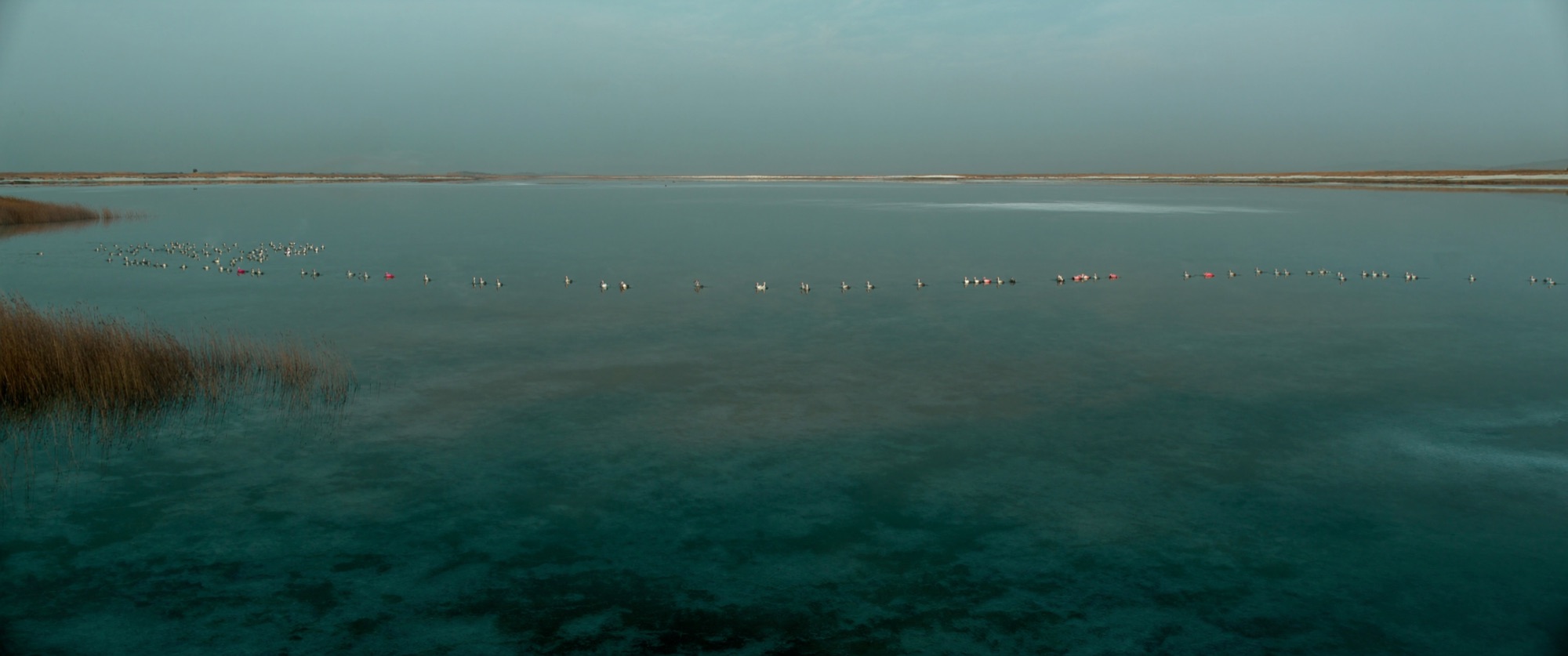
The fact that the geo-zones include no nature reserves does not mean that everything the aviation rules allow is fine over wetlands. BirdLife Cyprus writes that flamingos are particularly sensitive to disturbance in winter, when they need to rest and feed before the breeding season; drones overhead are among the disturbances that drive them from their feeding areas and cost them energy they need for migration. If you want to film at Paralimni Lake or the Larnaca salt lakes, keep well away. Where the birds spend the winter is set out in the guide to flamingos.
At Achna reservoir, the conditions for angling licences explicitly ban the use of unmanned devices for fishing or as a fishing aid.
For light drones, the registration requirement depends on whether a camera or sensor can capture personal data, and the Cypriot department's online training deals specifically with privacy and data protection. Some of the zones requiring authorisation, such as the one around Famagusta General Hospital, are expressly justified in the file on grounds of privacy.
The British Sovereign Base Areas and Suite 203
West of Sotira lies the British Sovereign Base Area of Dhekelia. There, and in Akrotiri, it is not the Republic of Cyprus that is responsible but the Sovereign Base Areas Administration. If you want to fly there, ask the administration first.
Suite 203 in Sotira is expected to be ready for occupancy in March 2027. If you want to fly from there, check the current geo-zone map before every flight, because the nearest National Guard zone is only just over a kilometre from the village centre, and respect the building's house rules and your neighbours' privacy.
Frequently asked questions
Can I fly a drone in Cyprus?
Yes, under the EU rules that have applied in Cyprus since 1 January 2021. In the open category no higher than 120 metres, within sight and without dropping anything. Check the official geo-zone map on drones.gov.cy before every flight.
Do I have to register as a drone operator in Cyprus?
Usually not. You register in the EASA state where you live, meaning an EU country, Switzerland, Liechtenstein, Norway or Iceland, and the number is valid in all of these states. You only register in Cyprus if you live there, or if you live outside the EASA states and Cyprus is the first country where you fly. Registration is required for drones over 250 grams and for lighter ones with a camera.
I live in the UK. What applies to my drone in Cyprus?
You register in the first EU country where you fly, in Cyprus through drones.gov.cy for 15 euros, from the age of 18. The EU does not recognise British training, so for A1 and A3 you take the online exam, unless you fly a class C0 drone under 250 grams.
Do I need a drone licence?
For A1 and A3, a certificate from the online training with an exam: 40 questions, a pass mark of 75 per cent, 15 euros in Cyprus, valid for five years. With a class C0 drone under 250 grams the exam is not compulsory. For A2, declared practical self-training and an additional 30-question exam are also required. Training from another EASA state is also valid in Cyprus.
Where can I find the no-fly zones in Cyprus?
On the civil aviation department's geo-zone map at drones.gov.cy: red means prohibited, yellow means authorisation required. The file can be loaded into the drone. According to the department, the Cyprus map preinstalled on many DJI drones is not the correct one.
Can I fly a drone in Sotira?
By our analysis of the 6 May 2025 file, the village centre is not in any geo-zone. The nearest, a National Guard zone, begins only around 1.1 kilometres away, however, and electronic countermeasures there may bring a drone down. Other zones belong to the Electricity Authority or surround Famagusta General Hospital and police buildings.
Can I fly near Larnaca Airport?
Not in the inner zone A. In zone B only with authorisation from the civil aviation department, applied for at least 10 working days in advance, and with third-party insurance of 1,000,000 euros. The zones begin around 27 kilometres as the crow flies west of Sotira.
Can I film flamingos at Paralimni Lake with a drone?
There is no geo-zone there, as the file contains no nature conservation zones. BirdLife Cyprus, however, explicitly names drones overhead as a disturbance that drives flamingos from their feeding areas. So keep well away, out of consideration for the birds.
How high can I fly a drone?
In the open category no higher than 120 metres above ground. Geo-zones may impose stricter limits or a complete ban.
What applies in the British Sovereign Base Area of Dhekelia?
The Sovereign Base Areas Administration is responsible there, not the Republic of Cyprus. If you want to fly in the base area, ask the SBA Administration first.
Sources
Every figure on this page comes from the sources listed below. Last checked: 7 November 2026. Please still check for yourself before you travel, as prices and timetables change.
- Cyprus Department of Civil Aviation, drones.gov.cy: home page (EU rules since 01.01.2021, operator registration for 15 euros, valid 3 years, from 18; training and exam for 15 euros, 40 questions, 75 per cent, 3 attempts, certificate valid 5 years; class C0 under 250 g without exam; pilots from 16)
- Cyprus Department of Civil Aviation: Open Category, frequently asked questions (120 m, visual line of sight, subcategories A1, A2 and A3, distance at least 5 m, 150 m from residential areas, privately built up to 25 kg, recognition of training from other EASA states; for A2 practical training and an additional 30-question exam)
- Cyprus Department of Civil Aviation: About Geo-Zones (R.A.A. (Κ.Δ.Π.) 190/2024, amended by R.A.A. (Κ.Δ.Π.) 123/2025, red and yellow zones, preinstalled DJI map not the correct one)
- Cyprus Department of Civil Aviation: Airport Geo-Zones (zone A prohibited, zone B with application 10 working days in advance and third-party insurance of 1,000,000 euros)
- Cyprus Department of Civil Aviation: Geo Zones JSON File (mandatory upload for classes C1, C2, C3, C5 and C6)
- Cyprus Department of Civil Aviation: geo-zone file CYP_GeoZones_06_05_25.json, own analysis on 07.11.2026 (141 zones, 29 prohibited, 112 requiring authorisation; distance as the crow flies from the map point for Sotira to the zone edge: National Guard 1.1 km, 4.3 km and 6.3 km, EAC 3.2 km, 6.7 km and 7.5 km, Famagusta General Hospital 4.1 km, police 4.4 km and 5.8 km, Larnaca Airport 27 km)
- Decree R.A.A. (Κ.Δ.Π.) 123/2025 on geographical zones (amending the annex to R.A.A. (Κ.Δ.Π.) 190/2024)
- EASA (European Union Aviation Safety Agency): FAQ Drones (registration in the country of residence, valid in all EASA states; residence outside the EU: registration in the first EU country; training from third countries not recognised)
- Swiss Federal Office of Civil Aviation (FOCA): Registrierung Drohnenbetreiber (registration in the EASA member state of residence; the EASA member states are all EU states plus Switzerland, Liechtenstein, Norway and Iceland; valid in all EASA member states)
- BirdLife Cyprus: When the Salt Lakes turn pink, The Greater Flamingos of Cyprus (drones overhead as a disturbance, especially in winter)
- Cyprus Department of Fisheries and Marine Research: Conditions for Recreational Fishing Licenses in Reservoirs for 2026 (unmanned devices for fishing or as a fishing aid prohibited)
- Sovereign Base Areas Administration: Administration Background (responsible for Akrotiri and Dhekelia)